
McKinsey Sea Wolf Game: Complete 2026 Guide
McKinsey doesn't publish pass rates, but most estimates put the failure rate around 70%. This guide gives you the strategy, scoring logic, and practice framework most candidates don't have.
What Is the Sea Wolf Game?
Sea Wolf Game is one of the three mini-games inside the 2026 McKinsey Solve assessment. It's a 30-minute timed exercise where you must clean 3 contaminated ocean sites by selecting the right microbes for each.
Each microbe has three numerical attributes (Permeability, Mobility, Energy) and a single trait. For every site you pick 3 microbes whose averaged attributes land inside the site's target ranges, while including at least one desirable trait and zero undesirable traits. Each microbe carrying the undesirable trait costs 20 points on that site.
Note: Sea Wolf Game is not the old McKinsey "Ecosystem Building" food-chain game. That game (8 species, calorie balance, predator/prey) was retired from the Solve assessment in early 2026 — see the Ecosystem Game retirement explainer if you've seen older guides describing it.
Reading is only half of it — you can run the timed Sea Wolf Game simulator to apply these rules under pressure, or take one free Sea Wolf Game run first. If you want to sanity-check a shortlist, check combinations in the Sea Wolf solver. For the other two games, start from the full McKinsey Solve prep guide.
Or run Sea Wolf next to the other two games.
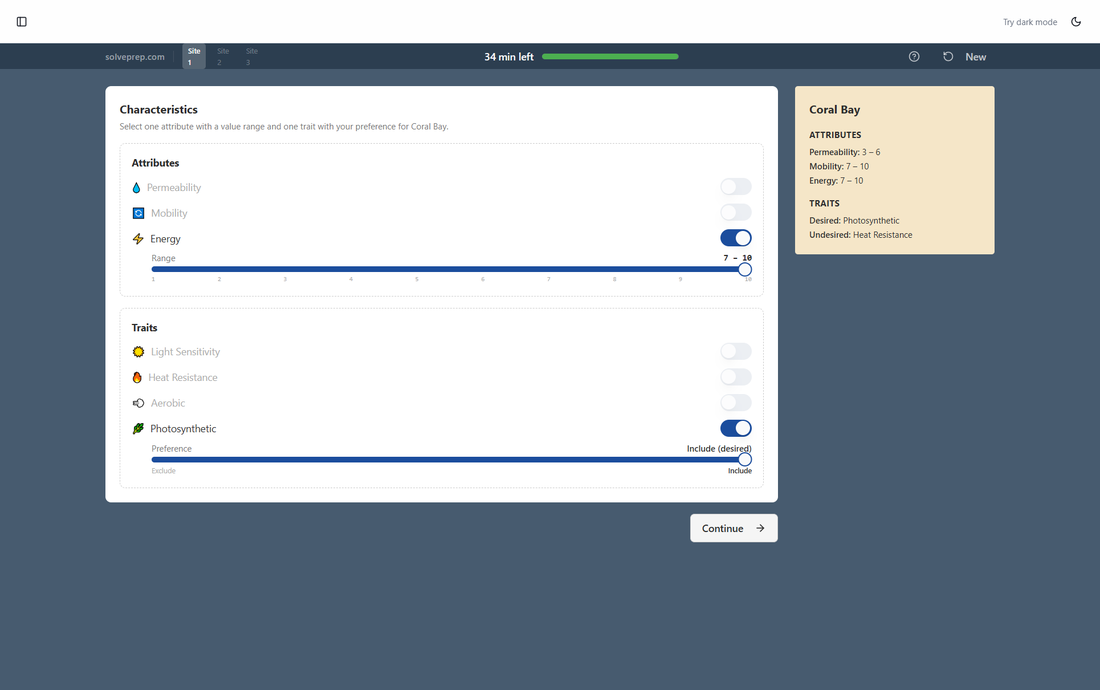
The filtering interface — Step 1 of each site
Game Structure: The 5 Steps (Per Site)
You repeat these 5 steps for each of the 3 sites. The later sites get harder because you're working with carry-over species and tighter time pressure.
Step 1 Set Filters (Characteristics)
Choose an attribute range (e.g., Permeability 3–6) and a trait preference (desired or undesired) to filter the species pool. The filter uses OR logic for desired traits — species that match the attribute range or have the desired trait pass through. Undesired traits are excluded using AND NOT logic.
Pro tip: Align your attribute range with the center of the site's target range for maximum pass-through of viable species.
Step 2 Categorize Species
Filtered species appear one by one. Sort each into: Current Site (add to this site's pool), Next Site (save for carry-over), or Reject. This is where strategic carry-over planning begins.
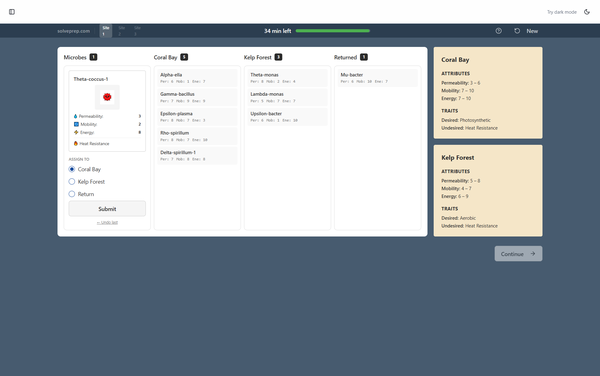
Categorizing species — Step 2
Step 3 Prospect Building
You're shown 3 species at a time, and you pick 1. This repeats 4 times, giving you 4 additional species in your pool. Choose species that complement your existing pool — fill attribute gaps or add missing traits.
Step 4 Final Selection
From your combined pool (categorized + prospect species), select your final 3 species for the site. This is the highest-stakes decision — your score depends entirely on this selection.
Step 5 Confirm Carry-Overs
The species you tagged "Next Site" in Step 2 come back for a keep-or-reject check once the next site's requirements are visible. Keep the ones that fit and reject the rest — this is your chance to plan ahead for later sites.
Scoring Breakdown
Each site starts at 100 points and loses points for every miss. The total max across 3 sites is 300. Here's exactly how the deductions work:
Attribute scoring: The average of your 3 selected species' attribute values must fall within the site's target range. It's all-or-nothing per attribute — in range costs nothing, out of range costs 20.
Trait scoring: If none of your 3 species has the site's desirable trait, you lose 20. Every species carrying the undesirable trait costs another 20, so two offenders cost 40 and three cost 60. A site can't go below 0.
Top Strategies to Score 250+
Read site requirements BEFORE filtering
Know the target attribute ranges and required traits before you touch the filters. Most candidates jump in blind.
Avoid the undesirable trait at all costs
Every species with the undesirable trait costs you 20 points, and they stack. This is the single most common mistake and the easiest to prevent.
Center your attribute filter on the target range
If the site needs Permeability 4–7, set your filter to 4–7. This maximizes the number of viable species passing through.
Plan carry-overs strategically
Strong species that don't fit the current site might be perfect for the next one. Use 'Next Site' categorization wisely — it's a competitive advantage.
Watch the clock
You have 30 minutes for all 3 sites. Spending too long on filtering (Step 1) is a trap. Aim for under 10 minutes per site to keep a buffer.
Free Trial vs. Full Simulator
The free trial is the full 3-site game on the real 30-minute clock. But practicing 1 fixed scenario won't prepare you for the real Solve — which generates a unique set of sites and microbes every single time. Serious candidates practice with variety.
Free Trial
- Full 3-site game, 30-minute clock
- 1 fixed scenario only
- No per-site score breakdown
- No progress tracking
Full Access
- Unlimited unique scenarios
- Full 3-site games
- Detailed scoring & analytics
- Leaderboard + AI Solver
Common Mistakes That Cost You 60+ Points
Including species with the undesirable trait −20 per species
Every species with the wrong trait costs 20 points, and they stack. Check every species before confirming.
Spending too long on Step 1 (filtering) Time penalty
Over-optimizing filters eats clock. Set filters quickly based on requirements and move on.
Ignoring carry-overs between sites Missed potential
Strong species for Site 2 or 3 might appear in Site 1. If you reject everything, you start later sites with an empty pool.
Optimizing for one attribute only −40% per site
All three attributes are scored equally. Nailing one but missing two still costs you 40 points.
Want the data behind these mistakes? See our synthesis of 312 candidate debriefs — frequencies, representative quotes, and one-line fixes for each pattern. For the quantitative side, The State of McKinsey Solve 2026 breaks down 26,622 simulator runs from 5,174 candidates, including which Sea Wolf Game submissions lose the most points.
What the Real Assessment Looks Like vs. Our Simulator
Our simulator replicates the exact 5-step structure, the same scoring logic, and the same 30-minute time pressure as the real McKinsey Solve. The key difference: McKinsey generates a unique set of sites and microbes every time — so should your practice.
Practicing the same fixed scenario over and over builds false confidence. The real test will throw you a combination you've never seen. Our full simulator generates infinite unique scenarios so you build genuine adaptability.

Our simulator — same structure, same scoring, infinite scenarios
You Get ONE Shot at the Real Solve
Candidates who pass report an average of 8 full practice runs (SolvePrep user data). Don't walk into the real assessment hoping your first try is enough.
120+ new candidates start practicing every day
No credit card required. Your first simulation is free.
Looking for other games? Browse all McKinsey Solve simulators