Updated September 25, 2026 · New: the 30-minute SFL
McKinsey Solve Simulation & Practice Test: All 3 Games, Timed
Play the Solve Before It Counts
Timed simulations of all three McKinsey Solve games: the Sea Wolf Game, the Red Rock Study and the Sustainable Futures Lab, now in both its 20- and 30-minute versions. You get an instant score and your weakest area after every run, and your first runs are free — see exactly what's included in our free McKinsey Solve practice. If you're looking for a McKinsey practice test: this covers today's McKinsey Solve assessment, not the retired Problem Solving Test (PST).
All 3 gamesReal per-game clocks20- and 30-minute SFL
9,000+candidates trained
8 practice runsis the average for passing candidates (SolvePrep user data)
"Failed at 38%. Two days on SolvePrep and I passed the real Solve." — Priya S.
You get one real attempt. Don't spend it learning the controls.
McKinsey doesn't publish pass rates, but most estimates put the failure rate around 70%. And the Solve is unforgiving by design: one attempt per recruiting cycle, no score, no feedback. You get a next-round invitation, or you don't.
Here's what trips people up. It isn't the math. It's first contact: three unfamiliar games, a hard clock on each, and mechanics you're learning while they're scoring you. That's the one variable you can take off the table before test day.
Almost nobody does it in time. In our data, 70.3% of candidates who gave us a test date didn't start practicing until the final 48 hours. Start a week out and you're already ahead of roughly nine candidates in ten.
Every McKinsey Solve game, simulated on its real clock
One account. Every game on your invitation, in the order you'll play it, scored the second the timer stops.
The treatment step, where a third of submitted sites miss.
Sea Wolf Game · 30 minutes
Three ocean sites. One clock. The trap is arithmetic, not biology.
Filter the microbes against each site's hard requirements, grow your prospect pool, then lock in the best three-microbe treatment before the clock pushes you on. Every minute you burn on site 1 is a minute site 3 never gets.
In our data: 33.5% of 21,456 submitted Sea Wolf sites failed on one thing: an attribute average outside the target range. That's roughly three times the rate of trait mistakes. It's also the most trainable error in the whole Solve.
What you practice:
All four steps at every site: filter, sort, grow the pool, pick the final three
Carry-overs between sites on one shared 30-minute clock
A per-site score out of 100, with every range miss and trait mistake itemized
The report and chart builder. The report is the most-lost Red Rock component in our data.
Red Rock Study · 35 minutes
An island, a stack of exhibits, and a clock that doesn't care how careful you are.
First the Study: pull the right values into your research journal, run chained calculations, write the report and build the chart. Then six independent cases. Once you move on to the cases, there's no way back.
In our data: there's no single weak phase. Candidates lost 41.2% of report points, 38.5% of analysis, 30.4% of chart building and 27.9% of cases. When losses spread that evenly, the clock is the enemy. So that's what we train you against.
What you practice:
Both parts on one 35-minute clock, one way only, like the real flow
Chained calculations where unrounded results carry forward
6 full Red Rock scenarios on Elite, each rerunnable
The opening ranking: the commitment every later answer is measured against.
Sustainable Futures Lab · 20 or 30 minutes
NEW: 30-minute version
The newest Solve game, and the one candidates underestimate most.
A priority ranking, then linked team decisions where every earlier choice shapes what comes next. No math. Just judgment, on a clock, that has to hold together from the first decision to the last.
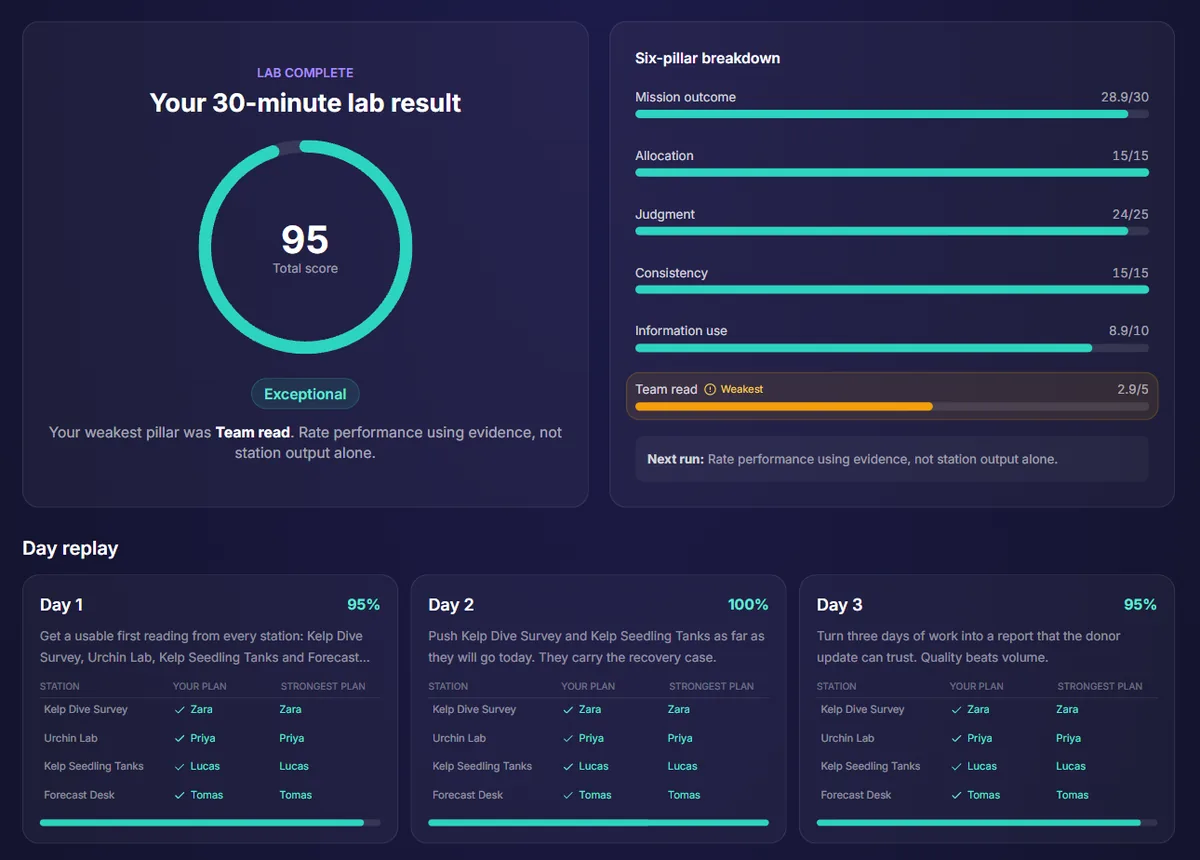
Two versions, one switch. 85-minute invitations carry the standard 20-minute SFL. Since late August 2026, 95-minute invitations carry McKinsey's new 30-minute version, rebuilt around running a small research team over three simulated days. Our SFL simulator runs both. Flip the switch to match your invitation and practice the exact test you're sitting. Not sure which one you have? Here's which version your invitation means.
In our data: consistency is the worst-performed component anywhere in our Solve data. SFL candidates lose 60.7% of the available consistency points. They judge single scenarios far better than they hold a line across all of them.
What you practice:
The standard 20-minute version and the new 30-minute team-management version
Consistency feedback that shows exactly where your answers drifted
Red Rock Study + Sea Wolf Game + Sustainable Futures Lab
Standard, 20 minutes
About 95 minutes (since late August 2026)
Red Rock Study + Sea Wolf Game + Sustainable Futures Lab
New team-management version, 30 minutes
Tutorials before each game are untimed and sit outside these totals. Whatever your number, every game on it is simulated here.
What you get after every run
An instant score the moment the clock stops. No waiting, no guessing.
Your weakest area, named, so your next run has a target.
On Elite, the full breakdown after every game: which components cost you points, plus progress tracking and the global leaderboard.
For the SFL, consistency feedback that shows where your answers drifted from your own ranking.
Reps compound fast. SolvePrep users score 20% higher on their best run than their first (SolvePrep user data).
Free vs Elite: choose your McKinsey Solve practice test plan
Free account
Elite: $79 one-time
Sea Wolf Game
1 full timed run
Unlimited runs, new scenario every run
Red Rock Study
1 full timed run
Unlimited runs across 6 full scenarios
Sustainable Futures Lab
1 trial run
Unlimited runs, 20- and 30-minute versions, new mission every run
After each run
Score and weakest area
Full score breakdown after every game
Extras
—
Sea Wolf AI Solver · progress tracking · global leaderboard
Pass Guarantee
—
Included
Price
$0 · no card
$79 once · lifetime access · no subscription
Pass the Solve, or get your money back
Complete 8+ full practice runs before your test date. If you still don't pass, forward McKinsey's outcome email within 30 days and we refund your Elite purchase in full. Why 8? Candidates who pass report an average of 8 full practice runs — that's why 8 is the Pass Guarantee threshold. On top of that, a 7-day money-back guarantee. Read the full guarantee terms.
"I only win if you pass. A refunded prepared candidate costs me $79; an unprepared one costs you the offer." — Tom, founder
Only need the Sea Wolf solver? Solver Only is $29, one-time (the Pass Guarantee covers Elite only).
Free account · no card · upgrade only when you're ready
Built by someone who has sat on the other side of the table
Tom, SolvePrep's founder, is a former McKinsey Engagement Manager who interviewed 150+ candidates at the firm. He built SolvePrep's three simulators and designed the scoring models behind them.
Everything here is built on data, not recollection. Our State of McKinsey Solve 2026 study covers 26,622 timed runs from 5,174 candidates, and we've collected 312 Sea Wolf debriefs from candidates who sat the real thing. That's how we know where points actually leak, and why each game block above leads with it.
And when the Solve changes, we move fast. McKinsey added the SFL in March 2026, and our SFL simulator logged its first runs on April 1. The 30-minute version followed about a month after the first 95-minute invitations surfaced. Every change goes on our dated What's New log.
Your McKinsey Solve practice plan, from invitation to test day
Today: take one free run of every game on your invitation. That's your baseline, and it rarely points where you expect.
Next: drill your weakest game on the clock. Read the breakdown after every run before you start the next one.
Before test day: reach 8 full runs. It's the average for passing candidates, and it's what qualifies you for the Pass Guarantee.
Yes, to start. A free account includes one full Sea Wolf run, one full Red Rock Study run and a Sustainable Futures Lab trial, all timed and scored, no card. Elite unlocks unlimited runs of all three games for $79, one-time.
It's built to feel like test day: the same three games, the same phases in the same order, and the clocks candidates get (30 minutes for Sea Wolf, 35 for the Red Rock Study, 20 or 30 for the SFL). The scoring is our training model, built from each game's structure. McKinsey doesn't publish its own, so no simulator can copy it. Here's how we score.
Yes. Our SFL simulator has a switch between the standard 20-minute version (85-minute invitations) and the new 30-minute version (95-minute invitations). Flip it to match your invitation, so you practice for the test you're actually sitting.
Your invitation's length tells you. About 65 minutes means Red Rock Study plus Sea Wolf Game. 85 adds the 20-minute Sustainable Futures Lab. 95 adds the new 30-minute SFL. You don't choose it; the invitation does.
Passing candidates average 8 full runs (SolvePrep user data). Yet 47% of game-user pairs in our study are a single run that's never repeated. One run is a baseline, not preparation.
Now. 70.3% of candidates in our data who gave a test date didn't start until the final 48 hours. A week out puts you ahead of roughly nine in ten.
Sea Wolf and the Red Rock Study have phone layouts. The real Solve runs on a laptop or desktop, though, so do your timed runs there, ideally with a mouse for Sea Wolf.
An instant score and your weakest area. Elite adds the full score breakdown after every game, progress tracking, the global leaderboard and, for the SFL, consistency feedback.
Elite customers who complete 8+ full runs before their test date and don't pass get a full refund. Forward McKinsey's outcome email within 30 days to claim.
No. SolvePrep is an independent practice platform, not affiliated with or endorsed by McKinsey & Company.
Your invitation came with a deadline. Your first run doesn't have to wait.
Join 9,000+ candidates who played the Solve here first.