
Sustainable Future Lab Guide 2026: Master McKinsey's SFL Assessment
67% of candidates fail the McKinsey Solve. The Sustainable Future Lab is McKinsey's newest module — a situational judgment test that evaluates how you make decisions within a team context.
What Is the Sustainable Future Lab (SFL)?
The Sustainable Future Lab — or SFL — is the third mini-game in the McKinsey Solve assessment, introduced alongside Sea Wolf (Ecosystem Building) and Red Rock (Redrock Study). It's a situational judgment test (SJT) that evaluates how you navigate team dynamics, stakeholder management, and ethical decision-making.
You'll face approximately 13 scenario-based questions within a 20-minute time limit. Each question presents a team situation with 3 possible responses. Your answers influence subsequent scenarios through adaptive branching — meaning the test adjusts based on your decision-making pattern.
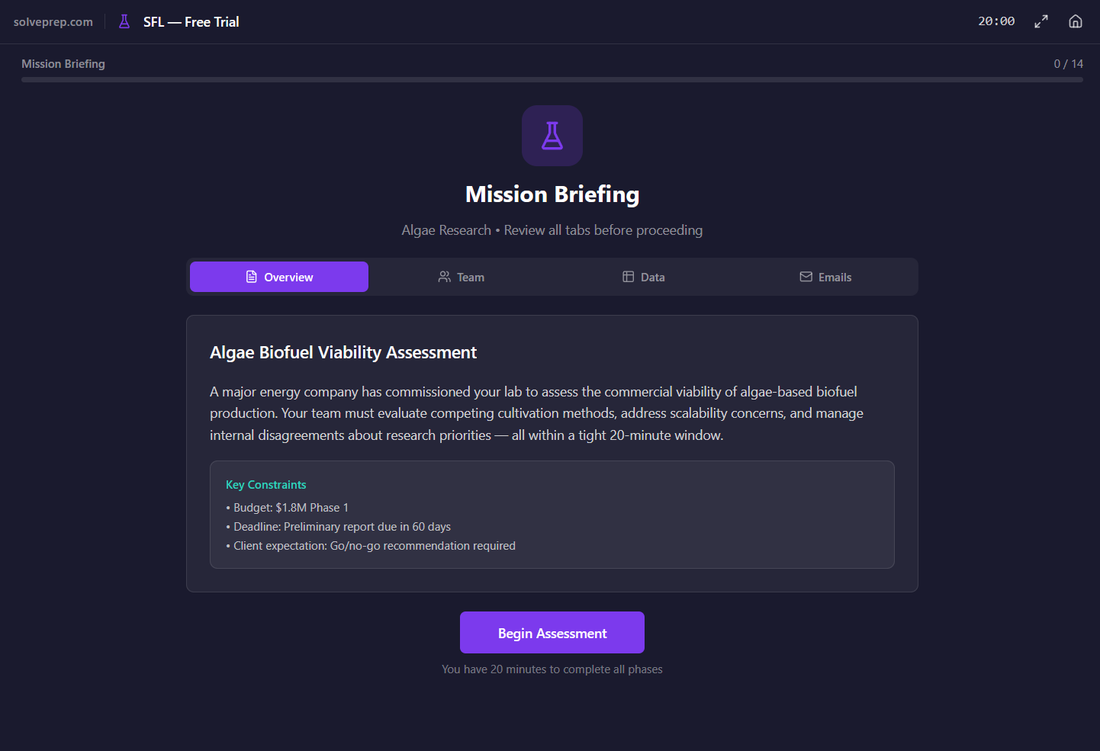
A scenario question — read the team discussion, then choose your response
Format & Structure
The SFL follows a sequential flow with distinct phases. Unlike Sea Wolf's ecosystem building or Red Rock's data analysis, SFL is entirely text-heavy — there are no calculations, charts, or data tables.
Mission Briefing
Read your research team context, meet team members, understand the sustainability challenge
Priority Ranking
Rank 5 action items in order of importance — tests strategic prioritization
Team Scenarios
11 situational judgment questions with adaptive branching based on your responses
Self-Assessment Survey
Consistency check — your self-reported style is compared against your scenario choices
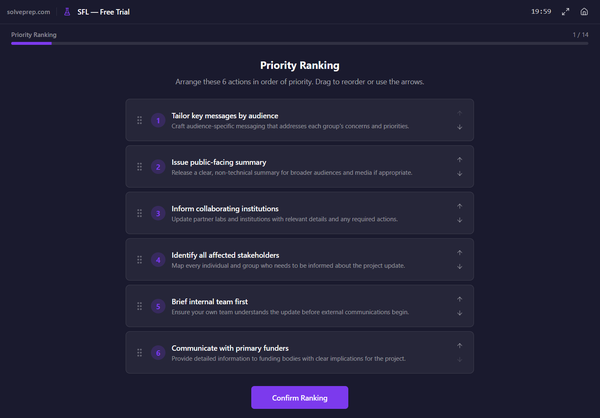
The Priority Ranking phase — order actions by strategic importance
The 5 Dimensions McKinsey Evaluates
Every scenario in the SFL maps to one or more of these five behavioral dimensions. McKinsey isn't looking for a single "right answer" — they're looking for consistent, thoughtful decision-making across all five areas.
Team Alignment
How you build consensus, manage disagreements, and ensure all team members feel heard. Collaborative approaches score highest here.
Stakeholder Management
How you balance competing interests — team needs vs. external partners vs. project goals. The best answers acknowledge all stakeholders.
Analytical Rigor
Whether your decisions are grounded in evidence and logic, or driven by instinct and shortcuts. Data-backed reasoning scores well.
Communication
How clearly and effectively you convey your reasoning to the team. Transparent, structured communication is valued.
Ethical Judgment
Whether you consider the broader impact of decisions — on the environment, the community, and long-term sustainability.
Decision Archetypes & Consistency Scoring
Each answer option maps to a decision archetype. The SFL doesn't just score whether you picked the "best" answer — it also measures whether your choices form a coherent decision-making style across all scenarios.
Collaborative
Seeks team input, builds consensus, prioritizes group alignment over speed. Best for team-oriented scenarios.
Analytical
Relies on data and evidence, proposes structured frameworks, defers to expertise. Best for complex or ambiguous situations.
Directive
Takes decisive action, provides clear direction, prioritizes momentum. Can score well when the situation demands urgency.
Adaptive
Flexes approach based on context. While flexibility seems ideal, inconsistency across similar scenarios lowers your consistency score.
💡 Key insight: Picking the "best" answer for each individual question but switching between archetypes randomly will hurt your consistency score. McKinsey values candidates who have a clear, coherent decision-making philosophy — even if it's not always the theoretically "optimal" choice.
Scoring Breakdown
Your SFL score is composed of three components. The total maximum varies, but here's how the weighting works:
Per-question scoring: Each scenario question is scored 0–3 based on how well your answer aligns with the ideal response for that situation. A score of 3 means you picked the best option; 1 or 2 means you picked a reasonable but sub-optimal option; 0 means a misaligned choice.
Consistency bonus: The consistency score analyzes your archetype distribution. If 70%+ of your answers follow the same archetype, you receive a higher consistency bonus. Random switching between archetypes on similar scenarios reduces this significantly.
Top 6 Strategies to Maximize Your Score
Read all three options before answering
The SFL presents nuanced options that can look similar at first glance. Reading all three before committing helps you identify the one that best matches your consistent approach.
Pick a decision style and stick with it
Consistency scores reward coherent decision-making. If you naturally lean collaborative, lean into it across all scenarios. Switching between archetypes to 'optimize' each question individually will backfire.
Pace yourself at ~90 seconds per question
With 20 minutes for ~13 questions (plus briefing and survey), you have roughly 90 seconds per scenario. Don't overthink — your first instinct aligned with your chosen archetype is usually right.
Consider stakeholder impact in every answer
The highest-scoring answers almost always acknowledge the impact on multiple stakeholders — team members, external partners, and the broader mission. One-dimensional answers score lower.
Don't second-guess on the self-assessment survey
The survey at the end checks whether your self-reported style matches your actual choices. Answer honestly about how you approached the scenarios — inconsistency between survey and actions lowers your score.
Treat the priority ranking seriously
It's only ~20% of your score, but it's free points. Think about impact, urgency, and dependencies between actions. The correct ranking usually follows a logical chain of prerequisites.
Free Trial vs. Full Simulator
The real SFL uses adaptive branching — your answers change the scenarios you see. Practicing with one fixed set teaches you that set's answers, not the judgment skills you need.
Free Trial
- 1 fixed scenario set
- No consistency scoring
- No adaptive branching
- No progress tracking
Full Access
- Unlimited scenarios
- Full consistency scoring
- Adaptive branching
- Leaderboard + progress tracking
Common Mistakes That Tank Your SFL Score
Switching archetypes to 'optimize' each question
Picking the theoretically best answer for each question but using different approaches (collaborative on Q1, directive on Q2, analytical on Q3) destroys your consistency score — which is 30% of your total.
Rushing through scenario text
SFL scenarios are nuanced and text-heavy. Skimming leads to missing critical context about stakeholder dynamics that changes which answer is best.
Ignoring stakeholder context
Many candidates focus only on the immediate team discussion and miss the broader stakeholder implications mentioned in the scenario context. The best answers acknowledge multiple perspectives.
Not reading all three options
Options B and C can look identical at first glance but differ in key ways — one might be collaborative while the other is directive. Reading all three before choosing prevents this.
Contradicting yourself on the survey
If your scenario answers show a collaborative pattern but you describe yourself as directive on the survey, the inconsistency lowers your score. Answer the survey honestly about how you actually approached the scenarios.
Spending too long on priority ranking
Priority ranking is ~20% of your score. Spending 5+ minutes perfecting it leaves too little time for the 11 scenario questions that make up 80% of your score.
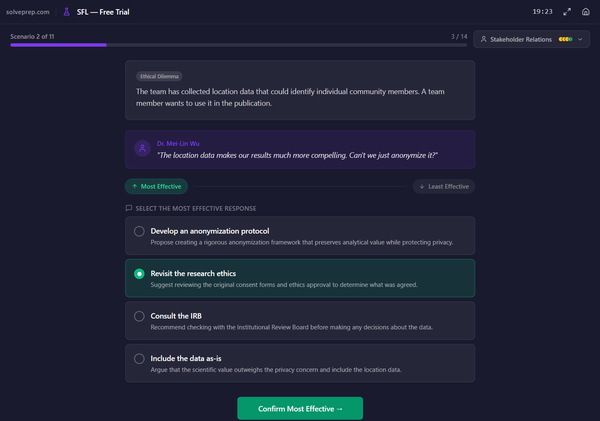
The self-assessment survey — be honest about your decision-making approach
What the Real SFL Looks Like vs. Our Simulator
Our simulator replicates the exact question format, the adaptive branching logic, and the same 20-minute time pressure as the real McKinsey Solve SFL module. The key difference: McKinsey's real assessment generates unique team scenarios every time — so should your practice.
We've built our scenario bank using organizational psychology research on SJTs, crowdsourced candidate experiences from consulting forums, and the known evaluation dimensions published by McKinsey. Each practice session gives you a different team, a different sustainability challenge, and different decision points.
The scoring engine mirrors the real assessment: per-question alignment scoring, consistency analysis across your archetype pattern, and the survey-to-behavior comparison. Practicing with variety builds genuine situational judgment — not memorized answers.
You Get ONE Shot at the Real Solve
The SFL is McKinsey's newest module — and most candidates have zero preparation for situational judgment tests. Those who practiced with our simulator reported feeling significantly more confident and making faster, more consistent decisions.
1,000+ candidates upgraded and passed
No credit card required. Your first simulation is free.
Looking for other games? Browse all McKinsey Solve simulators